


On this page
Why silica matters when you choose a countertopHow much crystalline silica is in each material?Where porcelain and sintered slabs fitQuartz and mineral surfacesNatural stone is not exemptWhat to ask before you signChoosing between them for a Florida kitchenFrequently asked questionsKey takeaways
- Crystalline silica dust is released when stone is cut, ground, drilled or polished. OSHA and NIOSH focus on the workers who do that.
- Silica content varies widely. OSHA and NIOSH list engineered stone at less than 0.2% up to 95%, granite at 10% to 50%, and marble and limestone below 5%.
- “Porcelain” and “silica-free” are not guarantees. Composition differs by product, so ask for the manufacturer’s specification or safety data sheet (SDS) for the exact color.
- Ask how and where your slabs will be cut: water-fed tools, dust extraction, and as little cutting at your house as possible.
Why silica matters when you choose a countertop
Silica matters mainly because of how a slab is cut, not how it sits in your kitchen. OSHA says respirable crystalline silica forms when stone, rock, concrete or mortar is cut, sawed, ground, drilled or crushed, and it lists stone countertop manufacturing among the activities that expose workers. Breathing the dust over time can cause silicosis, which OSHA calls an incurable lung disease. The joint OSHA and NIOSH hazard alert, updated in February 2026, is written for the people who manufacture, finish and install countertops.
The case reports are serious. A CDC report on 18 silicosis cases among stone fabrication workers in California, Colorado, Texas and Washington (2017 to 2019) included the first two U.S. deaths reported in this industry, and most of those workers used engineered stone. The same report says silicosis is preventable with effective workplace controls, such as water-fed tools, local exhaust ventilation and respirators when needed.
The documents we reviewed are about the people doing the cutting. This guide does not cover health effects for people who live with an installed countertop; that is a question for your physician. For the product itself, the useful questions are about its composition and how it will be fabricated.
How much crystalline silica is in each material?
It depends on the material and, for engineered stone, on the exact product. The OSHA and NIOSH alert gives typical ranges and notes that the exact content can only be determined by laboratory analysis of each stone. Do not confuse quartz, which is an engineered product, with quartzite, which is a natural stone. The alert lists them separately.
| Material | Typical crystalline silica (OSHA and NIOSH) | What to know |
|---|---|---|
| Engineered stone, including quartz | Less than 0.2% up to 95% | Some products are above 90%, others are below 50% or close to zero. Check the specific product. |
| Quartzite (natural) | 95% or more | A natural stone. Not the same thing as engineered quartz. |
| Granite (natural) | 10% to 50% | Varies by stone and color. |
| Marble and limestone (natural) | Less than 5% | Calcium carbonate-based stones contain little or no crystalline silica. |
| Porcelain and sintered slabs | Not listed in the alert’s table | Fired ceramic slabs. Silica content depends on the product, so ask for the SDS. |
| Reduced-silica and glass-based engineered surfaces | Under 0.2% to roughly 50% in the examples described | Marketing names vary (“mineral”, “silica-free”). The SDS is the check. |
A NIOSH laboratory study cited in the alert found that the respirable silica in grinding dust tracked the silica content of the stone. Engineered stone with less than 0.2% crystalline silica produced no detectable respirable crystalline silica, stone with less than 50% produced about the same level as granite, and stones with more than 70% produced the most.
Where porcelain and sintered slabs fit
Porcelain is not automatically silica-free, and it is not automatically a problem; it depends on the product. Porcelain and sintered slabs are fired ceramics, not resin-bound stone. Western Australia’s engineered stone ban, in force since 1 July 2024, defines engineered stone as a product with at least 1% crystalline silica and currently excludes porcelain and sintered stone from the ban. Tighter rules for all crystalline silica materials began there on 1 September 2024. A 2024 peer-reviewed review adds that there is uncertainty about how dust from harder sintered stone behaves, and calls for more research.

Our porcelain surfaces are described on the site as heat, chemical, scratch and stain resistant, and UV-stable. There is a second range on the porcelain B page. This article does not claim that any particular slab is silica-free. The manufacturer’s SDS for the exact color is the document to ask for.
Quartz and mineral surfaces
Engineered quartz covers the whole range, from very high silica to reduced-silica formulas, so the specific color matters more than the word “quartz.” The quartz surfaces page describes crushed natural quartz combined with polymer resins, a non-porous surface that does not need sealing. The mineral surfaces page describes a next-generation surface made from advanced natural minerals, often formulated to be crystalline silica-free.
Treat “often” and any asterisk or footnote on a label as a reason to ask a question, not as an answer. OSHA and NIOSH tell fabricators to verify crystalline silica content by consulting the safety data sheet for each product under consideration. A homeowner can ask for the same document.
Natural stone is not exempt
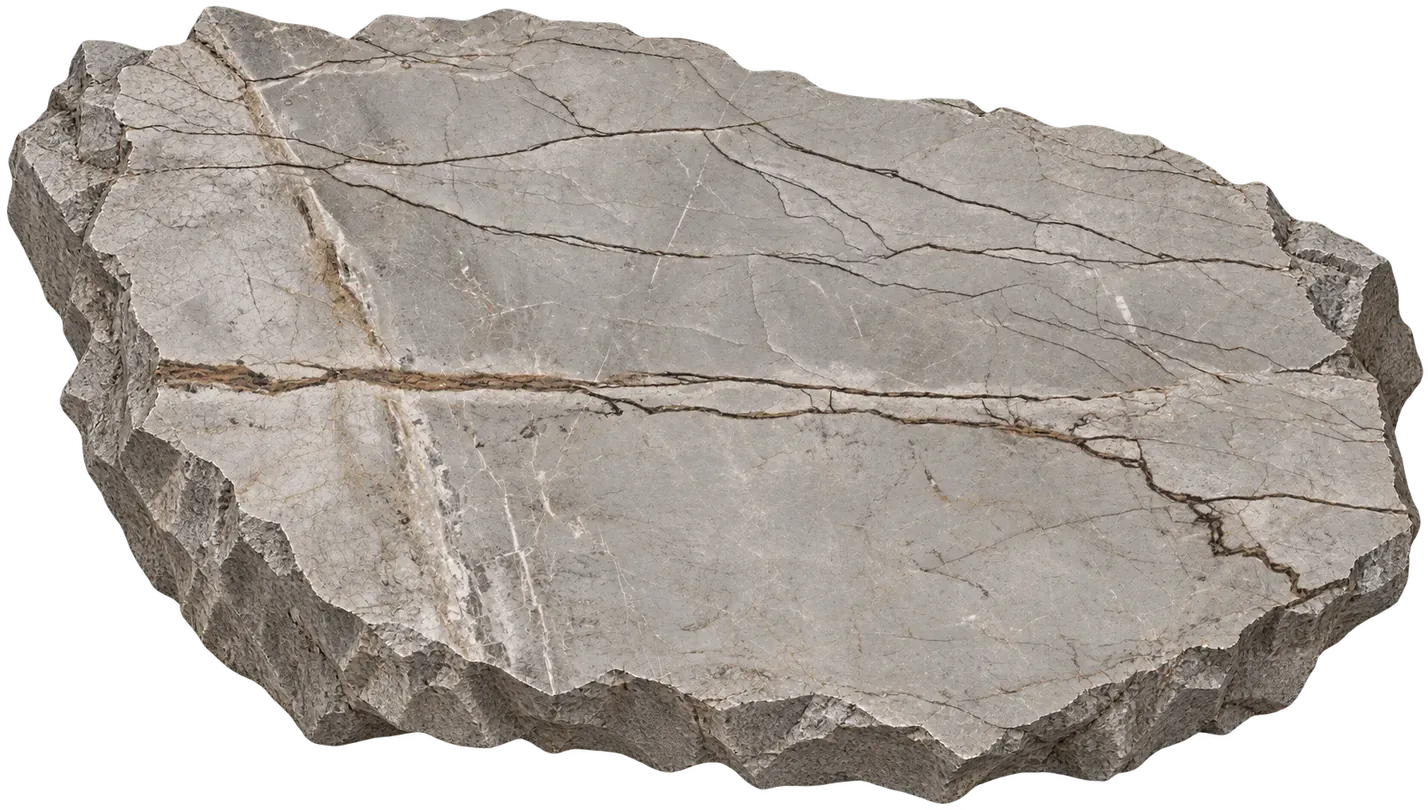
Natural does not mean low-silica. By the OSHA and NIOSH table, granite runs 10% to 50% and quartzite 95% or more, while marble and limestone are under 5%. OSHA sampled several shops; in one marble shop and one granite shop that used no dust controls, workers dry grinding green marble with 1.8% quartz were exposed to 39 and 45 µg/m³, and workers in the granite shop to 89 to 460 µg/m³. OSHA’s permissible exposure limit is 50 µg/m³ averaged over eight hours.
What to ask before you sign
Ask for three things in writing: the product’s SDS or specification, how the slab will be fabricated, and what will happen at your house. Use this list with any contractor or fabricator.
- The exact product name and color, plus the manufacturer’s SDS or technical data sheet showing crystalline silica content. If it gives only a range or a footnote, ask what it means and how it was measured.
- Where the slab will be cut and finished. The alert recommends doing as much work as possible in controlled shop conditions instead of at the installation site, using templates and laser measurement so that on-site finishing is not needed.
- How cutting is controlled: water-fed saws and tools, local exhaust ventilation or dust extraction, and no dry cutting or grinding. OSHA’s silica standards (29 CFR 1910.1053 for fabrication shops and 29 CFR 1926.1153 for work on construction sites) require engineering and work practice controls, and respirators where exposure still exceeds the limit.
- What happens if a cut cannot be avoided at your house. The alert says to work outdoors and use water to suppress dust.
- How the area is cleaned: wet methods or HEPA vacuums, with no dry sweeping and no compressed air.
The same questions apply to later changes. A new sink or cooktop cutout in a finished slab creates the same kind of dust.
Choosing between them for a Florida kitchen
Choose by how the surface will be used, then use the SDS to settle the silica question. Quartz suits busy indoor kitchens: it is non-porous, resists stains and needs no sealing. Porcelain is described as UV-stable and fade-resistant with strong heat resistance, which matters on sunny runs and anywhere near the outdoors. Mineral surfaces are described as often formulated to be crystalline silica-free, which is exactly what the SDS should confirm. If you want natural stone, ask the supplier about sealing, and ask the same silica questions.
At a design consultation you can compare these categories against your layout and budget. For a broader view of how a full kitchen project fits together, see our turnkey kitchen remodeling page, and for humidity and sun, our guide to humid and coastal Florida kitchens.
Frequently asked questions
What do OSHA and NIOSH say about quartz countertops?
OSHA and NIOSH focus on workers who cut, grind and polish stone. This is not medical advice; ask your fabricator for the safety data sheet (SDS) for your exact color, and talk to a physician about health questions. The risk the agencies describe is dust created during fabrication, so the questions that matter are about how your slab is cut and finished.
Is porcelain silica-free?
Not necessarily. Porcelain and sintered slabs are fired ceramics whose composition varies by product, and the OSHA and NIOSH table does not list them. Ask for the manufacturer’s SDS for the exact color.
Which countertop material has the least crystalline silica?
OSHA and NIOSH list marble and limestone at under 5%, and some engineered stones made with recycled glass in a cement matrix at under 0.2%. Those are examples, not a recommendation. Heat, staining, sun exposure and maintenance matter too.
What is the difference between quartz and quartzite?
Quartz countertops are engineered: crushed quartz bound with resin. Quartzite is a natural stone. OSHA and NIOSH list them separately, with typical crystalline silica of 95% or more for quartzite and less than 0.2% up to 95% for engineered stone.
What does “silica-free” actually mean?
The sources we reviewed do not give one label standard. OSHA and NIOSH describe engineered stones with less than 0.2% crystalline silica, and Western Australia’s ban defines engineered stone at 1% or more. Ask what the claim means, how it was tested, and whether a footnote qualifies it.
What exposure limit applies to fabricators?
OSHA’s permissible exposure limit for respirable crystalline silica is 50 micrograms per cubic meter of air, averaged over eight hours, with an action level of 25.
Keep reading
 Quartz surfacesQuartz surfaces for countertops and backsplashes, chosen together with your cabinetry.Read more
 Porcelain countertopsLarge-format porcelain countertop surfaces for kitchens in Southwest Florida. Browse the colors.Read more
 Quartz countertop downsides: and what to consider insteadQuartz is still widely chosen, but it has real trade-offs. Here is what published sources say about heat, sun, seams, edges, cost and silica, and how…Read more
Sources
- OSHA and NIOSH Hazard Alert: Worker Exposure to Silica during Countertop Manufacturing, Finishing, and Installation (NIOSH Publication 2026-101)
- OSHA Hazard Alert HA-3768-2026 (full text, PDF)
- OSHA: Crystalline silica
- CDC MMWR: Severe Silicosis in Engineered Stone Fabrication Workers, California, Colorado, Texas, and Washington, 2017 to 2019
- OSHA Hazard Communication Standard, Appendix D: Safety Data Sheets
- WorkSafe Western Australia: Engineered stone ban
- Ramkissoon et al. (2024), From Engineered Stone Slab to Silicosis, Int J Environ Res Public Health


