On this page
Which type of kitchen faucet should you choose?What is GPM, and how much flow do you need?Which faucet finish holds up best?How does Florida water affect a faucet?Do you need a filter, and what about lead?Will the faucet fit your sink and countertop?What should you ask the seller about the warranty?Frequently asked questionsKey takeaways
- Choose by sink and clearance: pull-down suits larger sinks and tall pots, pull-out suits small or low-clearance spaces.
- Federal rules cap kitchen faucets at 2.2 gpm at 60 psi. Some single-hole pull-down faucets on our fixtures page are listed at 1.5 GPM.
- UF/IFAS describes hardness minerals as everywhere in Florida groundwater, so expect scale on aerators and finishes. Follow the finish maker’s cleaning rules, because the wrong cleaner can damage a finish or void a warranty.
- Choose the faucet and sink before the countertop is cut, so holes are made in the shop.
- Ask for the written warranty before you buy, and ask what voids it.
Which type of kitchen faucet should you choose?
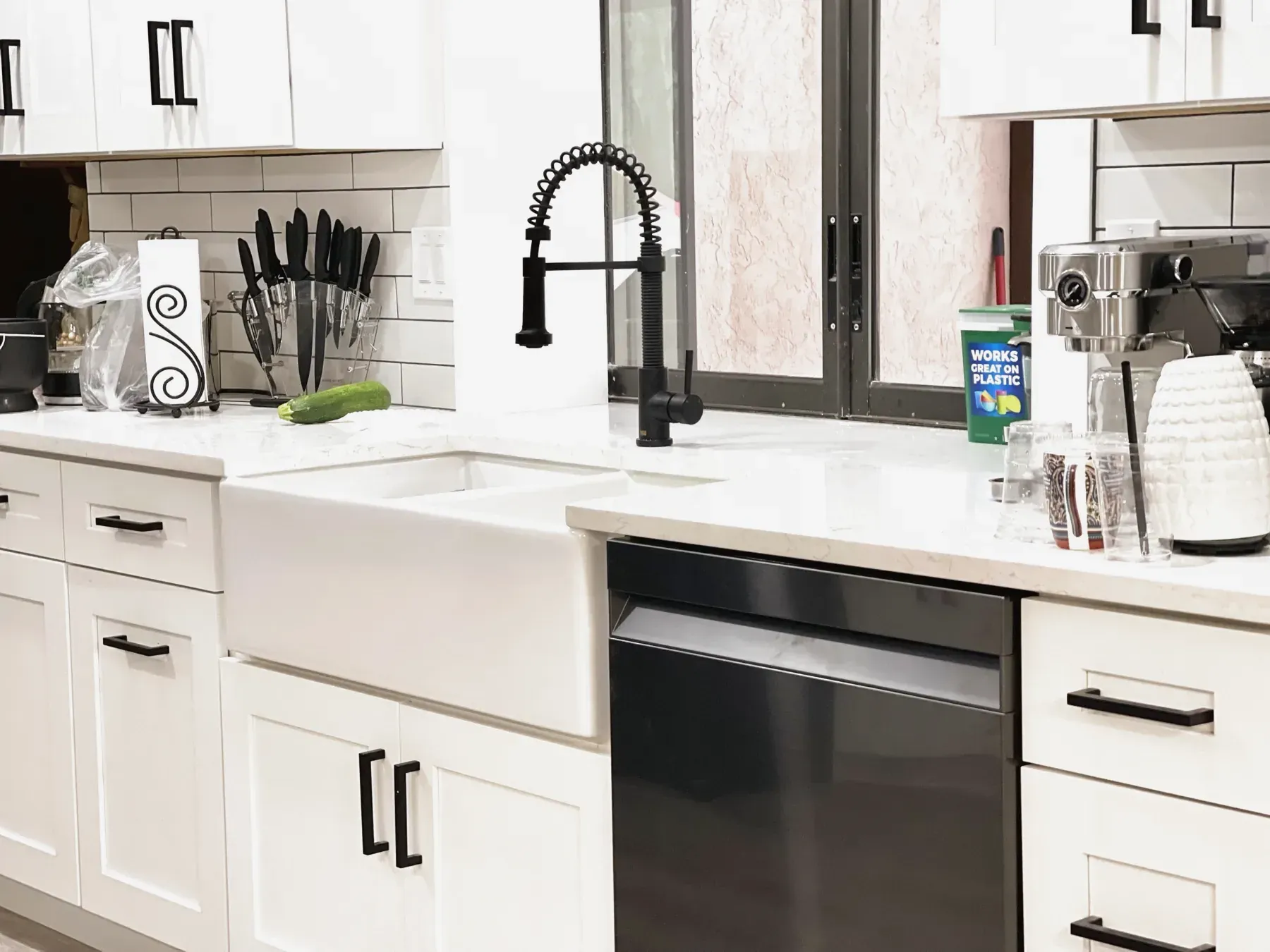
Choose a pull-down for a larger sink and tall pots, and a pull-out for a small or low-clearance space. A pull-down has a high-arc spout and the spray head pulls down toward the sink. A pull-out has a lower spout and the head pulls toward you. Hunker’s buying guide says proponents find the pull-down motion more ergonomic, since removing and using the sprayer takes one movement, while a pull-out often needs a regrip. Our kitchen fixtures page shows example faucets from Brizo and Moen; ask which models are available for your project. For recent product news, see Brizo kitchen faucet news and Moen’s latest kitchen faucets.
| Type | Best for | Check before buying |
|---|---|---|
| Pull-down (high arc) | Larger spaces and sinks; filling and washing big pots | Vertical clearance under a window or cabinet; usable hose length |
| Pull-out (low profile) | Small spaces, low windows | Whether you are comfortable regripping the head |
| Single-hole body | A clean look with one opening | If the sink has extra holes, a deck plate usually covers them; check the maker’s instructions |
What is GPM, and how much flow do you need?
GPM is gallons per minute, and federal rules (Department of Energy) let a kitchen faucet flow up to 2.2 gpm at 60 psi. Models rated lower, like the 1.5 GPM faucets listed on our fixtures page, use less water. At full flow, 1.5 gpm fills a one-gallon pot in about 40 seconds and 2.2 gpm in about 27 seconds. That is simple arithmetic, not a tested figure. If you fill stockpots often, compare both on a running display.
Which faucet finish holds up best?
No finish is maintenance-free; pick the look you want, then follow the maker’s cleaning rules exactly. One faucet maker’s guidance depends on the finish: PVD and electroplated finishes can take most household cleaners if rinsed right away, while powder-coat finishes should avoid abrasives, solvents and harsh cleansers. For every finish, a damp cloth with mild dish soap, a rinse and a soft dry cloth is the baseline, and for PVD and electroplated finishes that maker suggests an occasional non-abrasive wax, especially on matte or textured ones. It also warns that not following its cleaning instructions may void its warranty. Makers’ cleaning rules differ and can affect the warranty, so ask which finish type the model uses and get the care sheet for your exact model.
How does Florida water affect a faucet?
Florida groundwater is typically hard, so plan for scale on the aerator, spout and finish. UF/IFAS Extension says calcium and magnesium ions are everywhere in Florida groundwater, that they form chalky scale, especially when heated, and that heavy scale can build up in faucets, pipes, water heaters and dishwashers. It calls hard water a nuisance rather than a health concern. USGS classes water above 180 mg/L as calcium carbonate as very hard. Your utility’s Consumer Confidence Report, which the EPA lets you look up, is the place to start, and the utility can tell you your hardness if the report does not.
For dried water spots, that maker suggests a 50/50 mix of household vinegar and water for a limited time, then a rinse and dry. For PVD and electroplated finishes it says to avoid lime-scale removers; check the care sheet for your own finish. Keep vinegar off marble, because the Natural Stone Institute says marble’s calcite is attacked by mild acids found in kitchens. Near the coast, salt air adds a separate problem for exposed metal, covered in our guide to humid and coastal Florida kitchens.
Do you need a filter, and what about lead?
If you want filtered water, buy for the specific claim on the label, not for the word “filter.” The CDC says to look for the NSF mark and read which substances the filter removes. It adds that NSF/ANSI Standard 42 filters improve taste and odor and are not designed to make water safer, that Standard 53 certifies, for example, cyst reduction, and that filters which remove germs often do not remove chemicals. Change cartridges on the maker’s schedule.
Separately, the EPA says faucets and fixtures must average no more than 0.25% lead across the parts that contact water. Ask the seller for the lead-free certification for the exact model.
Will the faucet fit your sink and countertop?
Count the holes, measure the clearance, and choose the faucet before the countertop is fabricated. Check these before you order:

- Hole count and size: how many openings the sink and counter have, and what the faucet’s spec sheet requires.
- Deck thickness: the combined thickness of counter and sink rim that the mounting hardware must clamp.
- Clearance: height under windows and upper cabinets for a high-arc spout and the pull-down head.
- Reach: where the spout lands relative to the bowl and drain.
- Sink material and drilling: our sinks page lists quartz sinks in many sizes, depths and configurations; confirm the faucet openings with the sink maker.
Timing matters for the stone too. OSHA says silica dust forms when stone is cut, sawed, ground or drilled, so give the fabricator the faucet and sink specs before the slab is cut rather than drilling an installed counter. For more on that, see our guide to silica in countertops.
What should you ask the seller about the warranty?
Ask for the written warranty before you buy, and read what it covers, who services it and what voids it. The FTC says written warranties on consumer products costing more than $15 must be available before purchase, and warranties on products costing more than $10 must be titled “full” or “limited.” This guide does not state any maker’s warranty terms. Ask for the document for the exact model.
- Is the warranty full or limited, and does it cover the finish, the cartridge, other parts and labor?
- How long does each part of the coverage last, and does it start at purchase or installation?
- Who handles a claim, the maker or the seller, and what proof of purchase is needed?
- Is coverage limited to residential use, and does cleaning with the wrong product void it?
- Is the model certified lead-free, and are replacement cartridges and parts available?
- Will the model number, GPM, hole count and finish name be written on the quote or order?
When you have a short list, bring it to a consultation. Faucet, sink and counter are easiest to match when they are chosen together, as part of a turnkey kitchen remodel or a cabinetry and stone project.
Frequently asked questions
Is a pull-down or pull-out faucet better?
Pull-down suits larger sinks and tall pots, and some buying guides find it more ergonomic. Pull-out suits small or low-clearance spaces. Check clearance under windows and cabinets either way.
What flow rate should a kitchen faucet have?
Federal rules cap kitchen faucets at 2.2 gpm at 60 psi. Lower-flow models, such as the 1.5 GPM faucets on our fixtures page, use less water but fill pots more slowly.
Why does my faucet get white scale in Florida?
Florida groundwater carries calcium and magnesium, which form chalky scale, especially with heat. Your utility’s Consumer Confidence Report shows what applies to your tap. Clean with the method your finish maker allows, and rinse well.
Can a single-hole faucet go on a sink with three holes?
Usually, with a deck plate to cover the unused holes. Check the faucet maker’s instructions for your model.
Should I choose my faucet before the countertop is installed?
Yes. Hole positions and sink cutouts are made when the counter is fabricated, and OSHA says cutting or drilling stone creates silica dust. Give the fabricator your faucet and sink specs first.
Does a faucet filter remove everything?
No. The CDC says filters that remove germs often do not remove chemicals, and the reverse. Read the NSF label for the specific substances the filter removes.
Keep reading
 Kitchen fixturesPremium faucets from trusted brands such as Brizo and Moen: design, performance and no compromises.Read more
 Premium sinksA stunning selection of high-demand quartz sinks in a wide variety of sizes, depths and configurations.Read more
 Kitchen sink guide: quartz composite vs stainless steel and other materialsMaterial, depth, bowl layout and mounting style decide how a sink works years from now. Here is how to compare them before the countertop is cut.Read more
Sources
- Hunker: What Is a Pull-Down Kitchen Faucet?
- 10 CFR 430.32 (Cornell LII): Energy and water conservation standards, paragraph (o) faucets
- Moen: Faucet Finish Care and Cleaning
- UF/IFAS Extension Marion County: Water Quality Series, Hard Water
- USGS: Hardness of Water
- EPA: Consumer Confidence Reports (local report lookup)
- Natural Stone Institute: Marble, Onyx and Serpentine
- CDC: About Choosing Home Water Filters
- EPA: How does the Safe Drinking Water Act limit lead in pipes, plumbing fittings, fixtures, faucets, solder and flux?
- FTC: Businessperson’s Guide to Federal Warranty Law
- OSHA: Crystalline silica